Related Posts

Cape Verdean Folklore: Tales and Legends of the Islands
Unlike many countries, Cape Verde had almost no indigenous population before the islands were colonised, meaning its folklore was carried and created by the peoples who settled there during and after the 15th century. Enslaved Africans from various West African cultures, Portuguese colonisers (and later Brazilian influences), and others contributed strands to Cape Verde’s oral traditions. The result is a rich blend of African and Portuguese folklore where European fairy-tale motifs mingle with African trickster tales and local island mysteries.
Storytelling has long been a cherished art in Cape Verde’s culture – elders traditionally passed down stories in Crioulo around village gatherings, helping to preserve community history and values across generations. These folk narratives, often told in lively, shed light on Cape Verdean values, humour, fears, and worldview.
Tricksters and Animal Tales
One prominent element of Cape Verde’s folklore is the abundance of trickster tales and animal fables. These stories, often humorous and didactic, involve clever characters outsmarting stronger foes and imparting life lessons. Many such tales feature anthropomorphic animals acting like people – a legacy of both West African and European storytelling traditions.
The Wolf and the Goat
A central trickster figure is “Nhô Lobo” (Mister Wolf), a clever (and sometimes sly) wolf whose adventures convey folk wisdom and fundamental values. In Cape Verdean oral lore, Nhô Lobo often finds himself in contests of wits with other creatures or people, serving as either the trickster or the one being tricked, depending on the tale.
For example, a well-known cycle of stories pits Nhô Lobo against “Xibinhu” (the Little Goat) in a battle of wits. In one such tale from the island of Santiago, the hungry wolf tries to catch the goat through various tricks – at one point feigning a toothache to lure Xibinhu close – only to be repeatedly foiled by the little goat’s quick thinking. In the end, the clever Xibinhu typically outsmarts the wolf, escaping his clutches, often leaving the poor wolf hungrier than before.
These comedic encounters, reminiscent of West African trickster hare stories or Brer Rabbit tales, were traditionally used to entertain children while subtly teaching that wit can overcome brute strength. The folksy wisdom of the clever wolf, and those who outwit him, has long been a vehicle for imparting life lessons in Cape Verde.
Hares, Monkeys and Elephants
Cape Verde’s trickster repertoire isn’t limited to wolves and goats. Many other animal fables circulate in the islands’ oral tradition. Stories about hares (lebres) and monkeys showcase smaller animals outsmarting larger ones. For instance, one tale describes a cunning hare who devises a plan that embarrasses the proud elephant and the scheming wolf in a contest of strength, leaving the “big beasts” humbled by clever teamwork among the smaller creatures.
International Folktales
Such narratives echo classic “brains over brawn” motifs found across Africa and Europe, adapted to the Cape Verdean context. There are also Cape Verdean versions of international folktales: Elsie Clews Parsons’s landmark 1923 collection recorded local renditions of stories like Ali Baba and the Forty Thieves (known in Cape Verde as “The Seven Robbers”) and the Brer Rabbit-esque “Tar Baby”, suggesting that sailors and slaves brought well-travelled tales which then took on Cape Verdean flavours.
The Storytelling Tradition
It’s noteworthy that Cape Verde’s oral storytellers (kontador di stória) historically performed these tales in Crioulo, often infusing them with Cape Verdean humour, proverbs, and local references. In the days before television, children and adults would sit at dusk listening wide-eyed to these fables, which were as much entertainment as education. Through characters like Nhô Lobo – sometimes crafty, sometimes foolish – audiences learned virtues of humility, cleverness, and justice.
Today, many collections of Cape Verdean folktales, in both Creole and Portuguese, continue to preserve these animal stories, ensuring that the old wisdom and wit remain part of the national heritage.

Ghosts, Witches, and Supernatural Beings
Every culture has its things that go bump in the night, and in Cape Verdean folklore, the nights are indeed populated by an array of ghosts, witches, and supernatural creatures. Many of these figures were historically used to scare children into good behaviour or to explain misfortune in a pre-scientific way. They remain a vivid part of the islands’ folklore, reflecting both African spiritual beliefs and European medieval superstition.
Spirits or “alma penada” (restless souls) are familiar characters, and ghost stories are still swapped with a shiver in Cape Verde.
Witches (Bruxas) are among the most feared mythic beings on the Islands. In local lore, they are often depicted much like in Europe – as malevolent older women with supernatural powers. It’s said that witches can shape-shift into animals (especially nocturnal birds like owls) to carry out their deeds in secret, and they are blamed for causing illness or bad luck to those they curse. Fear of witchcraft (feitiçaria) ran so deep that even today some Cape Verdeans quietly acknowledge a lingering belief in witches’ power, though most will publicly dismiss it as superstition.
Alongside witches, one also hears of male sorcerers or feiticeiros in folk stories – equally dreaded figures capable of casting spells or curses. These beliefs in witchcraft’s harmful magic reflect an older worldview in which misfortune often had mystical causes.
The ghostly repertoire doesn’t end here. Cape Verde’s islands are home to a rogues’ gallery of boogeymen and phantom creatures that have long haunted the imagination. Some notable examples of Cape Verdean supernatural beings include:
Capotona
A frightening male spectre who appears at night wearing a great black cape. The Capotona lurks in dark streets or lonely paths after midnight, suddenly flaring open his cape to startle unsuspecting passers-by. Parents once evoked the Capotona to warn youngsters against roaming in the dark. The very image of a looming figure with a billowing cloak became a classic island nightmare.
Catchorrona
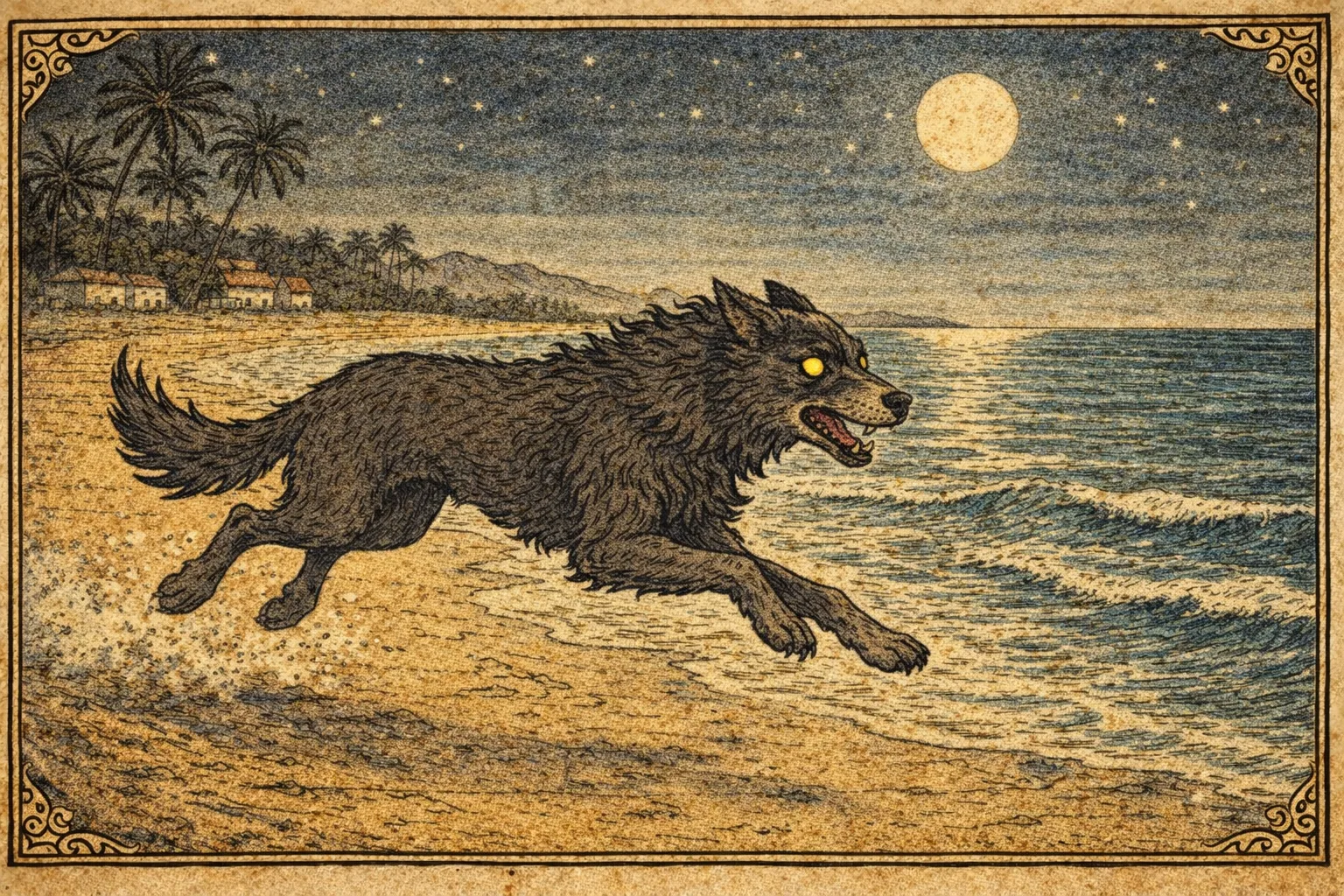
A supernatural giant hound (the name comes from cachorro, “dog”) that prowls at night. The Catchorrona is described as a huge black dog (sometimes headless, in some tellings) that attacks or chases people walking alone at night. This ghostly dog legend may have roots in European “black dog” folklore, repurposed to Cape Verdean settings – on a moonless night in a small village, the distant howling of a dog could easily feed such fears.
Gongón (Gongom)
A generic term for a terrifying apparition or bogeyman. To say “a gongón will get you” is to invoke any kind of ghastly, fright-inducing creature. In stories, a Gongón might be a ghoul or demon that hides in dark corners. (The blog anecdotes of older Cape Verdeans describe gongons as the ultimate childhood horror – just the word could send kids scampering home before dark.)
Canelinha
One of the strangest creatures, the Canelinha is described as a very thin, half-skeletal being – essentially half a person, “all bones”. Legend says Canelinha has only one side (split vertically) and must run in a perfectly straight line, lest its half-body fall apart. People imagined this spindly ghost sprinting rigidly down roads at night; if you zig-zagged or hid, perhaps you could avoid its path! Such macabre creativity shows the flair Cape Verdean storytellers had for scaring their listeners.
Maçongue
A peculiar blend of myth and history, os Maçongues are said to be evil Freemasons or sorcerers who trick unsuspecting victims into performing deadly errands. According to old belief, a Maçongue might pay someone to deliver a mysterious letter – only for the courier to later discover it was a “letter of death” that sealed their doom. This reflects a local fear of secret societies (the word maçon means ‘Freemason’ in Portuguese), which is transformed into a folkloric cautionary tale about dealing with strangers.
These figures – Capotona, Catchorrona, Gongon, Canelinha, Maçongue, and more – were the stuff of nightmares for generations of Cape Verdean children.
“These mythological figures filled our imaginations from sunset onward, as we huddled around the elders – our living storybooks and television – listening in both fear and fascination”.
The storytellers relished giving their audience a good scare, and indeed, many listeners would dread the dark walk home, seeing shadows of tamarind trees and boulders transformed into lurking ghosts by the power of suggestion. It was common practice to check under the bed before sleep, just in case a Catchorrona or Capotona had followed one home!
Little Friar with the Pierced Hand
Not all supernatural beings in Cape Verdean lore are malevolent or frightening; some are more whimsical or even protective. A famous example is the “Fradinho da Mão Furada” – literally the Little Friar with the Pierced Hand. This character, borrowed from old Portuguese folklore, is depicted as a mischievous house spirit in the form of a child monk with a hole in his hand. Through this magical hole, Fradinho can see into the future, foreseeing disasters or family losses. In tales, he is often a playful trickster (sometimes also called Diabinho da Mão Furada, a little devil) who might help or hinder households in unexpected ways.
Peaceful Spirit
Similarly benevolent is the “Espírito Tranquilo” or Peaceful Spirit, a gentle ghost said to guard homes and protect residents from harm. Far from scaring people, the Espírito Tranquilo is more like a guardian angel – a comforting presence believed to fend off burglars and misfortune in certain blessed houses or locales.
Evil Black Woman
Another poignant ghost in local lore is “Preta-Má”, literally “Evil Black Woman,” who, despite her name, elicits more pity than fear. She is described as a female spectre, dressed all in black, who wanders at night while weeping for her lost children. This legend of a grieving ghost mother bears resemblance to the Latin American La Llorona and likely echoes the historical tragedies of slavery or maternal loss. Cape Verdeans, especially on Santiago Island, speak of hearing Preta-Má’s cries on the wind – a haunting reminder of personal and collective sorrows.
Haunted Places
Apart from individual ghostly figures, certain places in Cape Verde have hauntings.
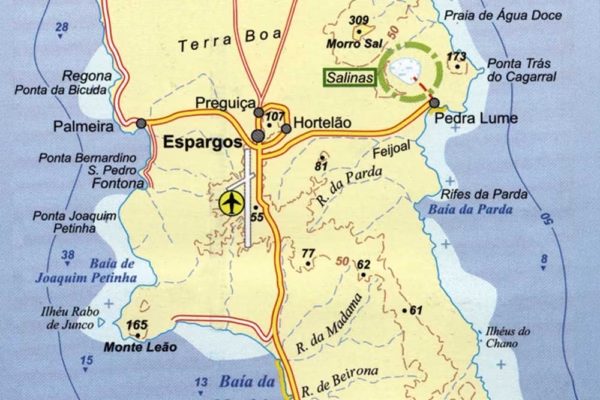
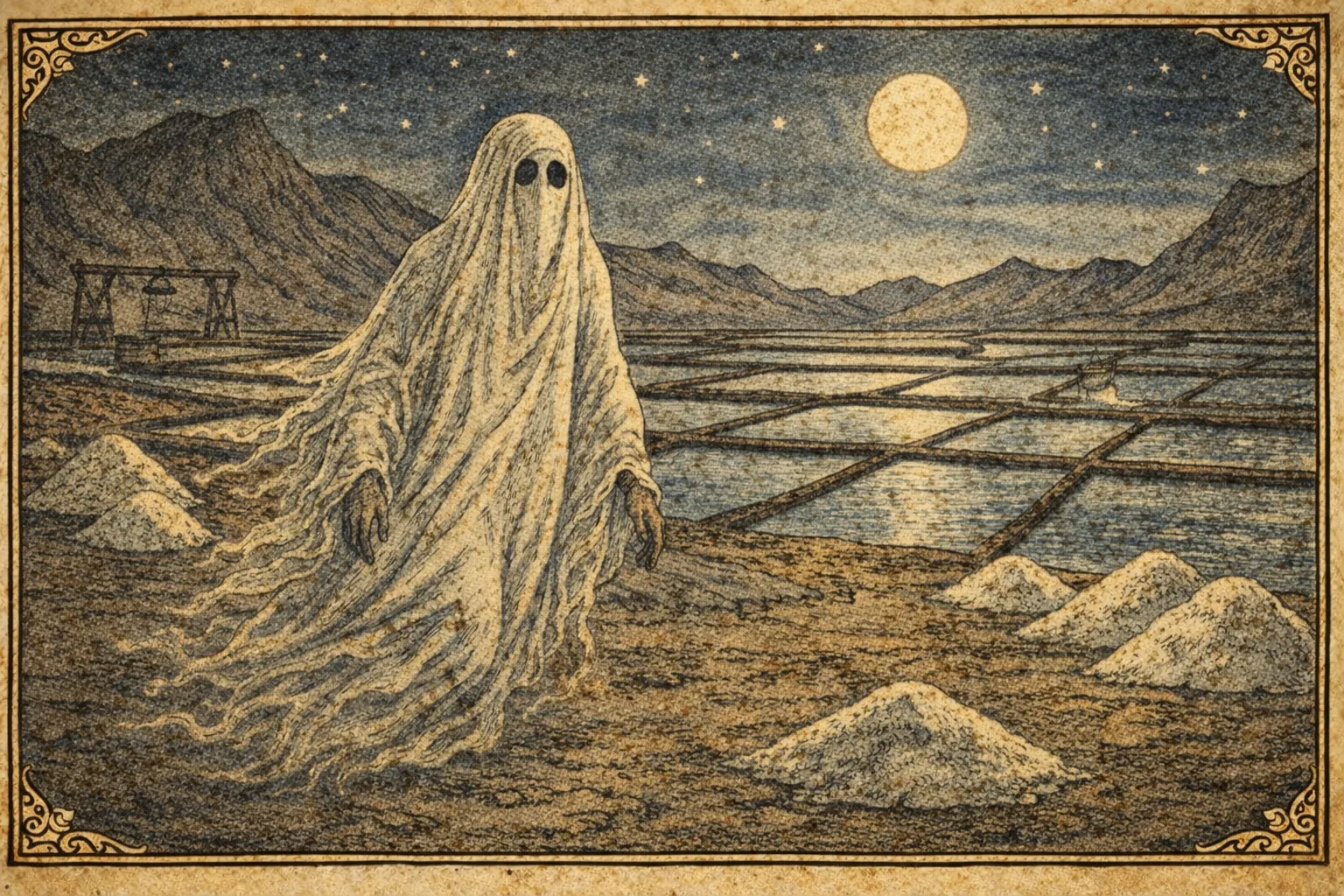
On Sal Island, for instance, locals still tell of the “Fantasma da Pedra”, a spirit said to haunt the old salt flats of Pedra de Lume. According to legend, this ghost is the restless soul of a slave who died while toiling in the salt mines, and it wanders the salt pans by night. The story likely arose from the very real suffering of slaves in Sal’s historic salt industry – their memory living on as a phantom roaming the gleaming white salt mounds under the moon.
On Boa Vista Island, the deserted village of Rabil is whispered to be stalked by wandering spirits – the ghosts of former inhabitants who abandoned the town. Visitors are warned that at dusk in old Rabil, one might just glimpse a flicker of someone who isn’t really there.
And on many islands, people speak in hushed tones about “Morte Seca”, the “Dry Death.” This spectral figure is said to appear before a person’s death, an omen that comes at night and makes eerie creaking noises. Those who claim to have encountered Morte Seca describe it as a gaunt, dried-out ghost that lurks near the moribund – a chilling Cape Verdean equivalent of the Grim Reaper. Such tales, though now termed lendas urbanas (urban legends), still send a shiver down the spine and reveal a lingering mystique in Cape Verdean belief, when the line between superstition and reality blurs in the dark hours.
Legendary Heroes and Love Tragedies
While ghosts and ghouls dominate the night, Cape Verdean folklore also celebrates legendary heroes and poignant love stories that have become part of local legend. These are the tales that explain landmarks or commemorate admired figures, adding a touch of human drama to the folklore mix.
Nhô Roque
Foremost among folk heroes is Nhô Roque, a name that carries almost mythical status in Cape Verde. Nhô Roque is remembered as a legendary strongman and protector figure, and stories about him vary from island to island. In some tellings, he was a real historical person of extraordinary strength; in others, a benevolent spirit.
On the island of Brava, Nhô Roque is revered as a guardian spirit who lives in a seaside cave and emerges to protect the island’s people whenever great danger looms. If a violent storm approaches or, in older legends, pirates threaten to land, Nhô Roque’s spirit allegedly comes forth from his cave to shield Brava, embodying the island’s will to survive.
Elsewhere, Cape Verdeans speak of Nhô Roque as a kind of Cape Verdean Hercules – a man of super-human strength and heroic deeds whose exploits left a lasting mark on the nation’s imagination.
Though the details differ, all versions agree that Nhô Roque’s emblem symbolises protection and resilience. To this day, Brava residents honour Nhô Roque’s legacy, sometimes quietly invoking him during fierce weather, and his name has been given to parks and places in tribute to the enduring legend.
The Legend of the Praia dos Amores (“the Lovers’ Beach”)
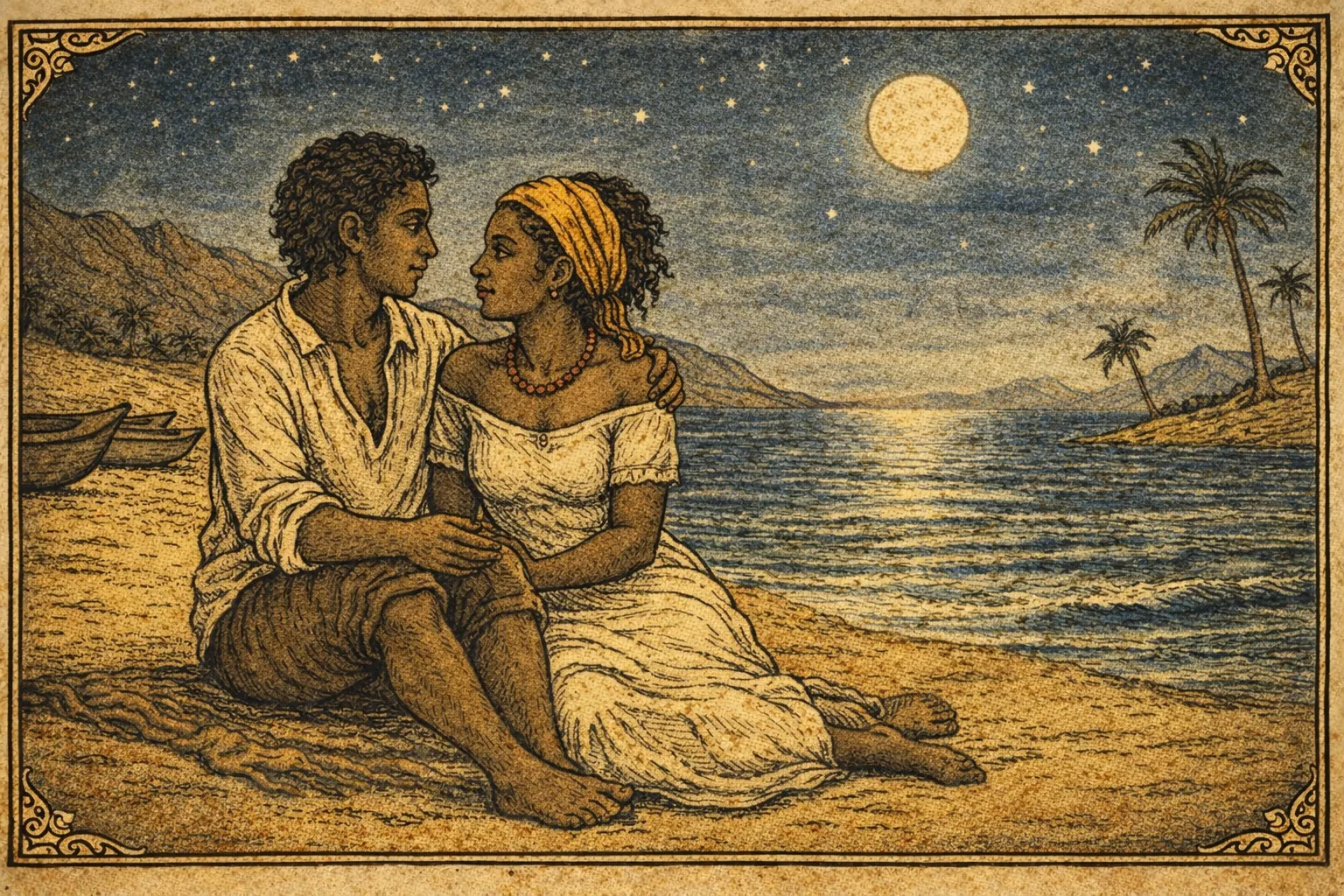
Cape Verdean folklore also includes romantic tragedies – forbidden love stories that end with ghosts or enchanted places. One famous narrative is A Lenda da Praia dos Amores – the Legend of the Lovers’ Beach. This tale recounts the heartrending romance between a young fisherman and an upper-class Portuguese noblewoman during colonial times. Their love was illicit and star-crossed, forcing the couple to meet in secret on a secluded beach. According to the legend, the two lovers ultimately died (some say by drowning, others by family intrigue) without ever being able to share their lives openly. It’s said that their souls still haunt the beach where they used to rendezvous, and that late at night, one can hear the sighs of the departed lovers on the sea breeze.
Far from being frightening, this ghostly presence is considered gentle and sacred – the beach became regarded as an almost hallowed spot for lovers, a place where vows made might be blessed by the spirits of those who loved and lost.
The Praia dos Amores legend, while not globally famous, is cherished locally as a Cape Verdean Romeo and Juliet tale, embodying themes of love, injustice, and the hope that true love may transcend even death.
Maritime Myths and Island Lore
As an island nation born of volcanoes and surrounded by the sea, Cape Verde has developed folk tales that grapple with the mysteries of nature – from volcanic mountains to the vast Atlantic – often through mythological explanations. These legends provided meaning and narrative to natural phenomena that were otherwise beyond local control, like volcanic eruptions or mirages at sea.
The Giant of Pico do Fogo
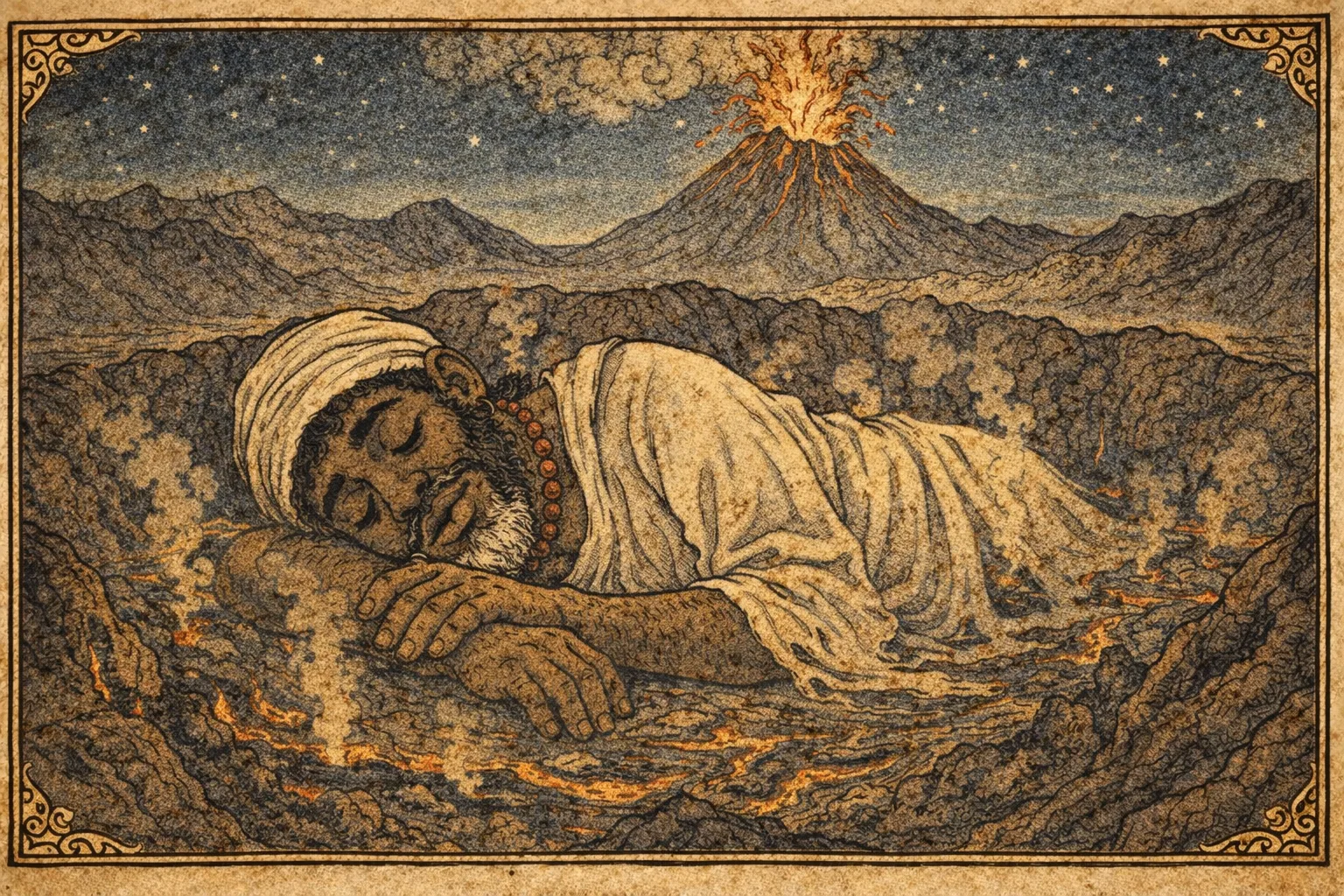
One popular tale centres on the active Volcano of Fogo, the highest peak in Cape Verde. Local myth says that, inside Pico do Fogo, lies a giant who slumbers deep in the earth. Whenever the giant awakens and shifts, the volcano erupts in fury, shaking the island of Fogo with fire and ash. This legend likely arose to explain the unpredictable eruptions that historically terrified inhabitants – casting them as the rumbles of a giant helps frame a dangerous natural event in human terms.
Even today, when Fogo volcano grumbles, some elders might half-jokingly remark that the old giant under the mountain must be stirring again.
The Enchanted Island
The sea, too, holds its share of Cape Verdean legends. Sailors and fishermen have long whispered about mysterious islands and creatures in the Atlantic waters around the archipelago.
One enduring legend speaks of an “Ilha Encantada” – the Enchanted Island – sometimes called Ilha Fantástica or Ilha da Quaresma (Lent Island). According to the lore, this phantom island is visible only at certain times of year (usually around Easter), appearing as a distant landmass on the horizon. Many have claimed to spot it glinting in the summer haze, but whenever ships attempted to reach it, the island would fade or vanish into the mist, forever out of grasp. Such stories echo the real historical myths of sailors (early Portuguese explorers once noted phantom islands on maps) and may also be linked to atmospheric mirages. In the imaginations of Cape Verdeans, the Enchanted Island became a symbol of tantalising discovery – a bit of the magical unknown lingering at the edge of the map.
Odjo d’Água
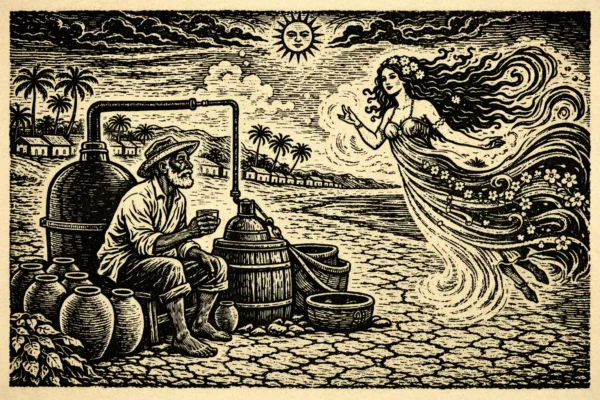
Sea creatures, half-human and half-fish, also glide through Cape Verde’s mythic seascape. Among fishermen’s tales are warnings of the “Odjo d’Água”, literally “Eyes of Water” in Creole, described as mermaid-like marine creatures inhabiting the coastal waters. These beings are akin to sirens or merfolk: beautiful, elusive creatures who sometimes even form relationships with humans, for better or worse. Stories abound of sailors who swore they saw a woman with a fish’s tail basking on a remote rock, or of young men lured by a mysterious, pretty face emerging from the waves. Such myths may be rooted in sightings of manatees or seals. Still, in folklore, the Odjo d’Água are entirely magical – a reminder that the ocean, provider of life, also harbours enchanting secrets.
Other maritime legends are more eerie.
Spectral Sailors
Cape Verde’s long history of navigation and shipwrecks gave rise to tales of spectral sailors. It is said that the spirits of those who died in shipwrecks – the naufrágios – sometimes wander the islands in ghostly form, seeking eternal rest. These drowned souls are portrayed as gentle ghosts, usually harmless but endlessly forlorn, appearing on beaches or cliffs where shipwrecks occurred. On foggy nights by the shore, one might imagine a lone figure in old seafarer garb, gazing out to sea – a soul that hasn’t yet realised it can never sail home. Such stories reflect both the respect for the sea’s dangers and a compassionate desire to remember those lost to the waves.
The Tale of Escondido Oru of Pirate Drake
Not all sea legends are tragic, however. Some promise fortune instead of misfortune. A well-known Cape Verdean legend invites treasure hunters with the tale of Escondido Oru – hidden gold buried somewhere in the islands. The most famous version claims that the 16th-century English pirate Sir Francis Drake hid a pirate treasure in Cape Verde, and that the map to the treasure was lost, never to be found. Generations of locals have speculated about secret troves of coins or jewels concealed in caves or under old colonial ruins.
While no such pirate hoard has ever been confirmed, the Drake story persists as a romantic mystery – part history (since Drake did raid the islands) and part hopeful fantasy that unimaginable wealth might lie beneath one’s very feet.
The Legacy and Preservation of Local Folklore
Cape Verde’s folk tales and legends have survived through centuries of change – from Portuguese colonial rule to independence in 1975 to the modern diaspora – thanks mainly to the strength of oral tradition. Storytelling was historically an evening pastime and community glue. Elders (often grandmothers or village patriarchs) served as living libraries, passing on knowledge and culture through spoken word. This oral heritage is considered a fundamental pillar of Cabo Verde’s cultural identity, preserving essential aspects of history, language, and values that lack written records. Women, especially, were key in transmitting Crioulo tales across generations, weaving folklore into songs, lullabies, and daily chatter.
However, like many oral traditions worldwide, Cape Verdean folklore faces challenges in the modern era. Urbanisation, formal schooling, television and the internet, and the massive emigration of Cape Verdeans abroad (today more live in diaspora than at home) mean that the old storytelling sessions are far less common than before. Younger generations are at risk of growing up without hearing about Nhô Lobo’s antics or the Gongon’s terrifying chase. There is a sense of urgency among cultural scholars, who spurred efforts to document and revitalise folklore so it isn’t lost.
Fortunately, some preservation initiatives have taken place. As early as 1917, American anthropologist Elsie Clews Parsons recognised the value of Cape Verde’s folk narratives – she collected over a hundred folk tales and riddles from Cape Verdean immigrants (mainly of African-Portuguese descent) in New England, eventually publishing Folk-Lore of the Cape Verde Islands in 1923. This was one of the first compilations to put Cape Verdean oral literature into print (in both Creole and English), ensuring stories like “The Seven Robbers,” “The Biggest Liar,” and “Compadre Death” were preserved outside their native context.
Later, in the 20th century, Cape Verdean authors and folklorists stepped up: Manuel Bonaparte Figueira published Contos e Lendas de Cabo Verde in 1963, a slim but seminal volume of traditional tales collected on the islands.
More recently, writers such as Tomé Varela da Silva and others have recorded folk stories and proverbs in Creole, and cultural organisations have begun transcribing and translating oral narratives for educational use. Bilingual storybooks and even online platforms now feature tales like “O Lobo e o Chibinho” (Wolf and Goat) or “Família Póbri i Galinha Inkantada” (The Poor Family and the Enchanted Chicken) in an effort to keep them alive for new generations.
Equally important is the role of festivals and oral performance in keeping folklore alive. Cape Verde has festivals such as Tabanka and Kolá San Jon, which, while primarily musical and religious, incorporate elements of folk narrative and masquerade that echo old legends. In diaspora communities (for example, among Cape Verdeans in New England or Portugal), one can still find elders telling children about the Catchorrona or singing lullabies about the Bruxa.
The Cape Verdean Creole language itself, now standardised in writing by some scholars, carries many idioms and sayings born from these folk tales, thus weaving the old stories invisibly into everyday speech.
In conclusion, the folk tales and legends of Cape Verde form a remarkably rich cultural heritage – one that reflects the islands’ blended African-European roots and the creativity of a people who, in isolation and hardship, turned to storytelling for wisdom, comfort and fun. From the clever Nhô Lobo teaching life lessons, to the eerie Capotona scaring kids home before dark, to the poignant ghosts of lovers and sailors that give history a human face, these stories run the gamut of human experience. They have been kept alive through oral tradition and are increasingly being polished and recorded like precious gems of cultural memory. Clear, colloquial and captivating, Cape Verdean folk narratives continue to resonate with all who hear them, offering a “sodade” (nostalgic longing) for the past and a guide for the future. As we enjoy these tales today, in English, Portuguese, or Crioulo, we partake in an age-old Cabo Verdean practice – sharing stories to make sense of the world, polishing the lore so that it may shine for generations to come.
Bibliography & Sources:
- Folklore from the Cape Verde Islands, Elsie Clews Parsons, Cambridge, Mass., New York, American Folk-lore Society, 1923, via Internet Archive;
- A Simbiose entre o Animal e o Homem no Imaginário e nos Valores em Contos Tradicionais da Lusofonia (Portugal e Países Africanos de Expressão Portuguesa), Palavras Prévias, Repositório Aberto, Universidade Aberta;
- Lobu ku Xibinhu: The Wolf and the Little Goat, Julio Soares, Countafrica
- O Mistério do Vento, O Canto do Mar, UWM World Languages, 2025;
- Estórias e Lendas de Cabo Verde… Adriano Lima, Arrozcatum, 2014.